Cellulose: A Plant Cell Biology game by Genius Games is the latest in their line of quality educational games. In this colorful worker placement game, you and up to 5 players compete over limited resources to build up the cell wall. Grow your plant and gain Health Points as you complete critical plant cell activities.

There are two game boards – the Main Game Board is double-sided (for the number of players) in which you’ll place your workers to accomplish critical plant cell activities. The second smaller board is the Plant Board, where players will track their plant growth – up the shoots into the leaves and down the roots.
Cellulose Gameplay
The game plays over a series of rounds (days), with the following 3 phases: Sunrise, Daytime, and Evening.
Sunrise Phase
In this phase, players collect Water and CO2 income (and additional benefits) according to the Plant Board and any Cell Component Cards with Sunrise bonuses. At the beginning of the game, Players start in the middle of the board, where the shoots and roots meet and get one CO2 cube. During the Daytime Phase, you’ll have a chance to grow your plant shoots and roots to gain better bonuses.


Daytime Phase
Each player has 3 Action Markers (beakers) in their color to place on the board. Take turns placing one on an available Action Space and take the corresponding action. You may then play 1 Cell Component Card from your hand. Action Spaces come in two types: Small Action Spaces (for 1 Action Marker) and Large Action Spaces (for any number of Action Markers of different colors).

Daytime Actions
In the image above, you can see the current Water Level, with the water marker set at the amount of water available.
- Collect Water (Xylem) – Collect Water, move water marker down, add up to 3 Water to your region in the Central Vacuole
- Collect CO2 (Stomata) – Collect CO2, move water marker down if possible
- Make Carbohydrates – Convert 6 Water and 6 CO2 into 1 Carbohydrate
- Build Cell Wall – Place 1 Carb on the Cel Wall to earn Health Points and 1 Water to your Central Vacuole region
- Make ATP (Mitochondria) – Convert 1 Carb into 5-6 ATP
- Collect Proteins (Ribosomes) – Collect 3-5 Proteins (red cubes)
- Collect Plant Hormones (Cytoplasm) – Collect 2-3 Plant Hormones for plant growth (orange wooden tokens)
- Plant Growth – Grow plant up into shoots or down into roots
- Take First Player Marker (Nucleus) – Also draw a card
- Take Cell Component Cards – Pay the Card cost and place in front of you

Central Vacuole
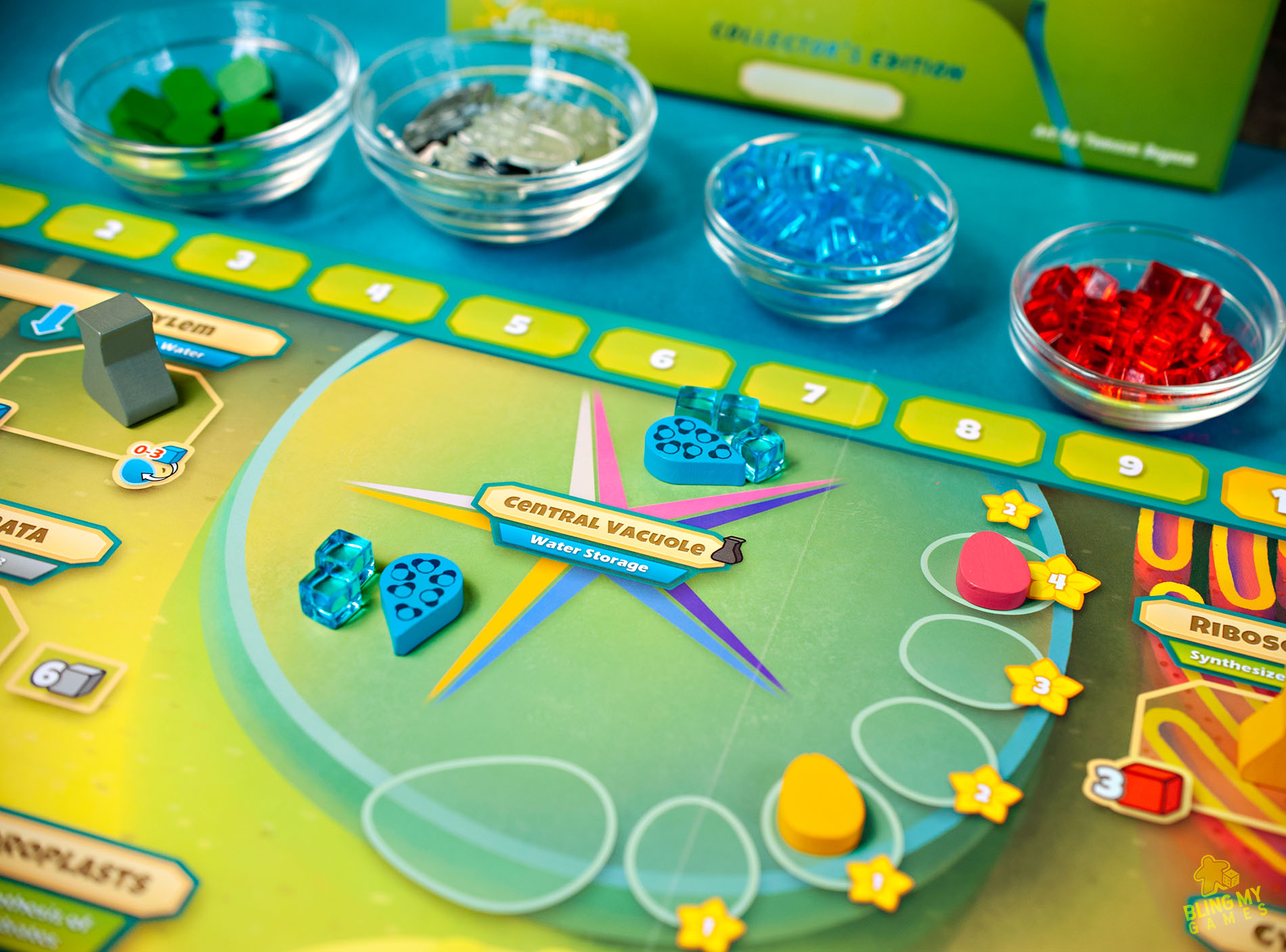
When you build the Cell Wall, you place a green Carbohydrate token on the Cell Wall, scoring those Health Points and adding one water to your color wedge of the Central Vacuole. This cell wall is split into three sections, increasing the amount of water in the Evening Phase after completing each section.
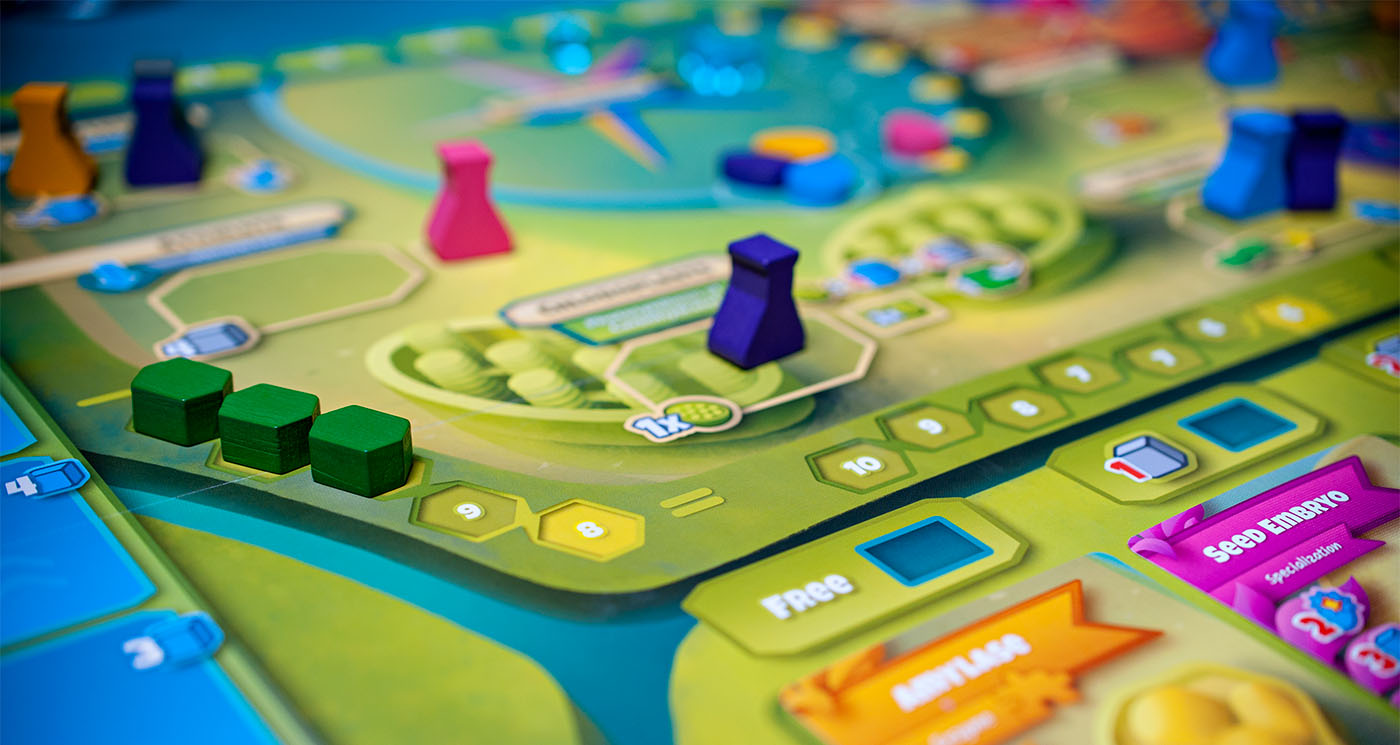
The first player to take the Mitochondria action will receive 6 ATP tokens. The Collector’s Edition offers these fabulous metal ATP tokens. There is one more spot to get 5 ATP tokens.

Cell Component Cards
After any action, you may play a card from your hand. There are four types of Cell Component Cards – Enzymes, PSVs, Specialization Cards and Starches.

Evening Phase
After all Action Markers are placed, perform the following actions to ready for the next day:
- Retrieve Action Markers
- Central Vacuole Majority Reward – the person who contributed the most Water will:
- Advance their Central Vacuole Marker and score the Health Points
- Remove the water from only their region
- Take a Gray Action Marker for the next day
- Cell Wall – Add 1 Carbohydrate from the supply to the cell wall
- Reset the Water Level Marker according to the last fully-completed section of the Cell Wall.
- Cell Component Cards – Refresh cards for next round

Cellulose: End of Game
The game will end once the cell wall is complete, with a line of green carbohydrates, immediately if the wall is built in the Evening Phase. If the wall is completed by a player during the Daytime phase, gameplay continues until all Action Markers have been placed.
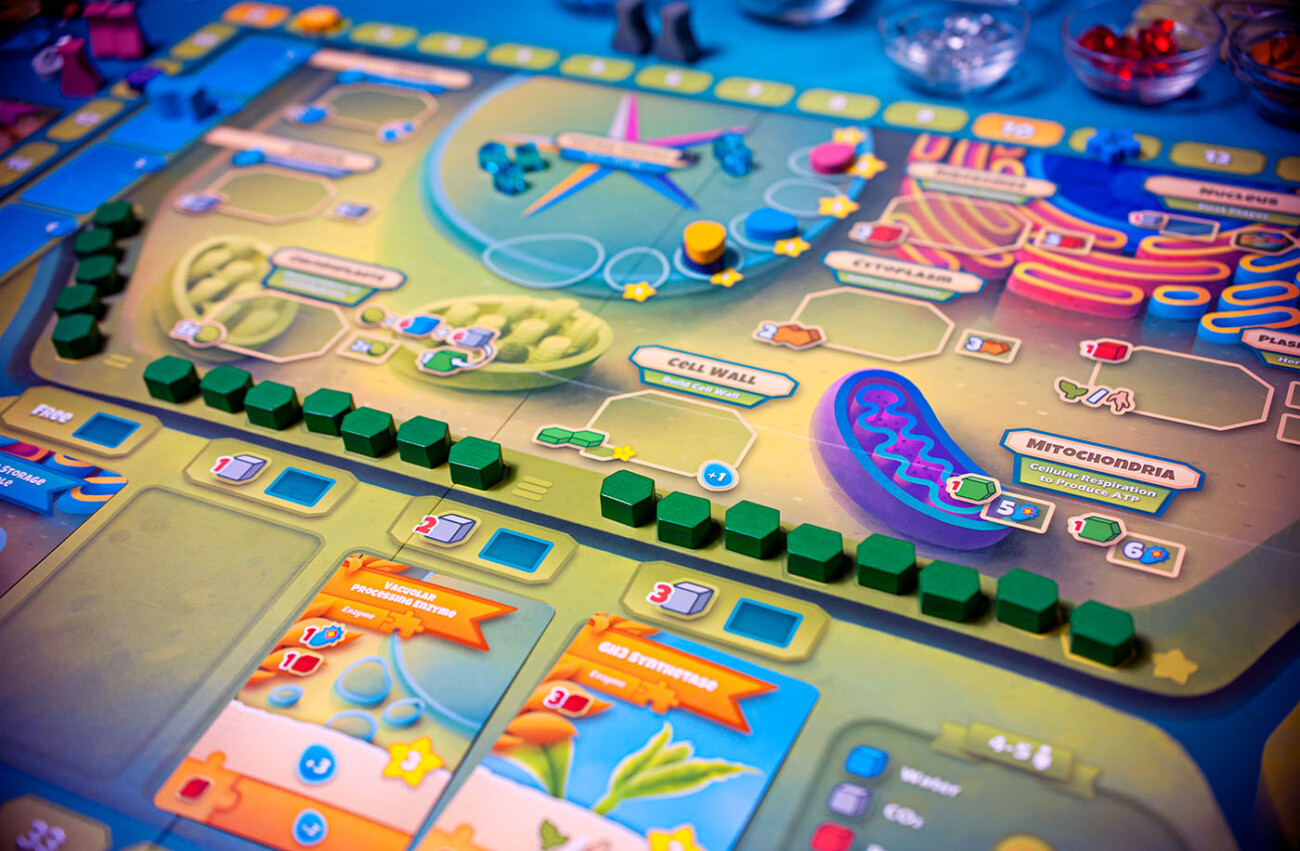
Score the Central Vacuole points and play any number of Cell Component Cards in your hands, ignoring all abilities and benefits aside from the Health Points.
Calculate Scores
Starting from Health Points already accumulated throughout the game, add the following:
- Carbohydrate – 4 Health Points each
- Specialization Cell Component Cards
The player with the most Health Points wins!
Mangrove/Cactus Scenarios
There are two included scenarios in the game.
- In the Cactus scenario, water is scarce but valuable.
- The Mangrove uses the alternate Mangrove plant board side. You can move up and down and sideways along the mangrove roots, but struggle through harsher conditions.
I enjoyed using the Mangrove side especially as the Plant Growth Hormone worker placement spot remains valuable throughout the game as you can move along the roots.
Cellulose Game: Solo
In the Solo game, you play against an automa opponent named Ivy. She will compete with you for worker placement spots and Health Points.

Ivy has her own small player board, double-sided for an easy and a medium/hard game. The only difference is that Ivy will have additional bonuses when she gains a Strategy.

I played the solo game a few times on the Easy side to get a feel for her gameplay. I lapped her around the board both times, but the Medium/Difficult side was more of a competition. Our scores were often within 15 points of each other.
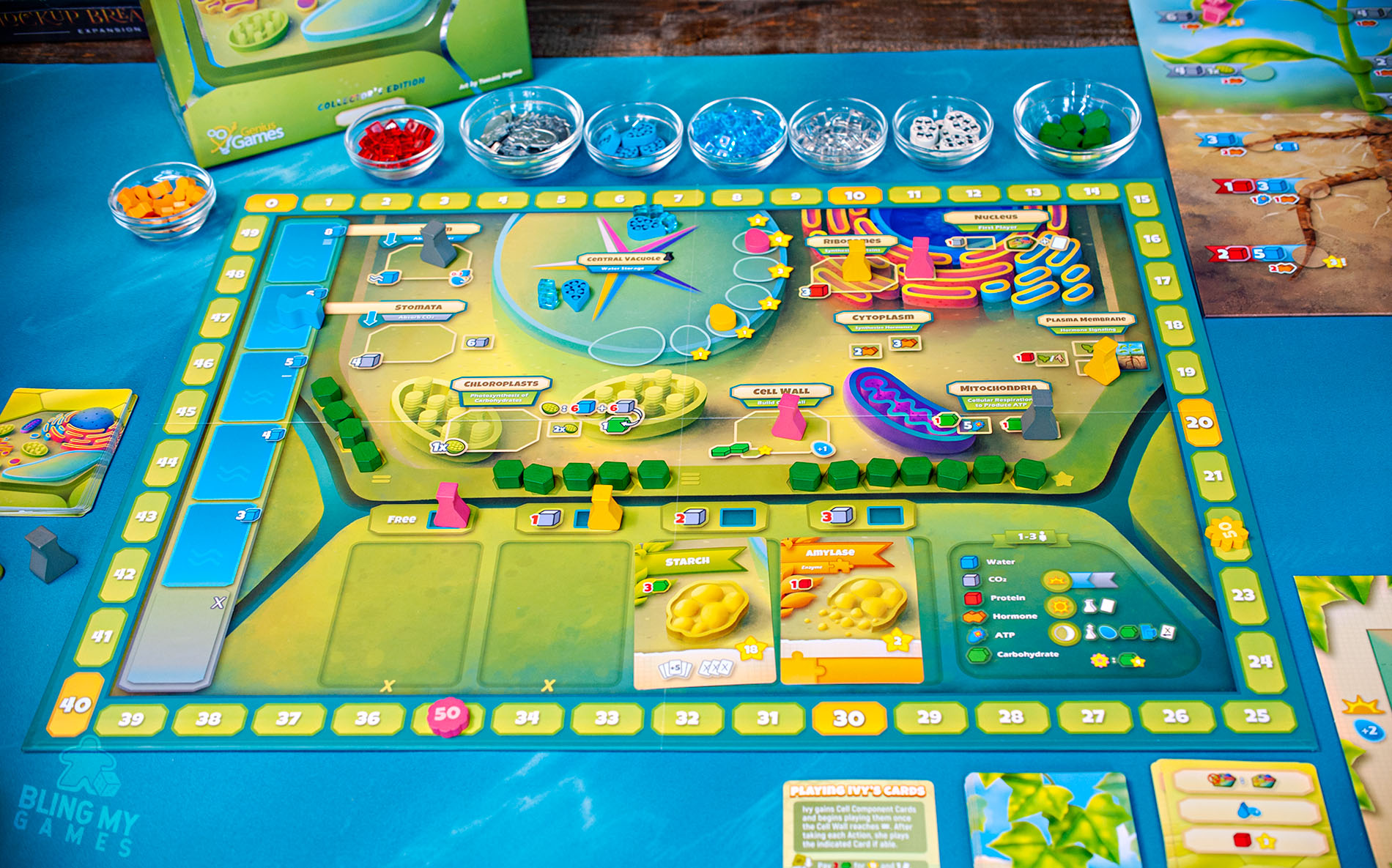
Cellulose Collector’s Edition
The Collector’s Edition version comes with the metal ATP tokens, screen-printed player markers and this insert. I was delighted to see that the insert is more than enough room for premium-sleeved cards! The scoopable wells perfectly fit all the components as well.

Genius Games has a series of beautifully done educational games with exceptional artwork, components and gameplay. You can pre-order on their site. The Cellulose Kickstarter has finished, and I received my copy this past weekend; it’s available for retail on March 23, 2022.
